
Why the NYT told photographers not to update Photoshop 2027
The New York Times bars Photoshop 2027 (version 28.0+) on assignments because hidden AI features can tag photos as AI-generated in metadata.
Checked and updated 26 November 2026 at 03:55 UTC
Key points
- The New York Times emailed its freelance and contributing photographers asking them not to use Adobe Photoshop 2027 (release 28.0.0 and later updates) on assignment. A Times spokesperson confirmed the rule to The Verge on November 24, 2026.
- The reason: some features in the new version use generative AI 'in ways that may not be apparent', and using them can add metadata that labels a photo as AI-generated.
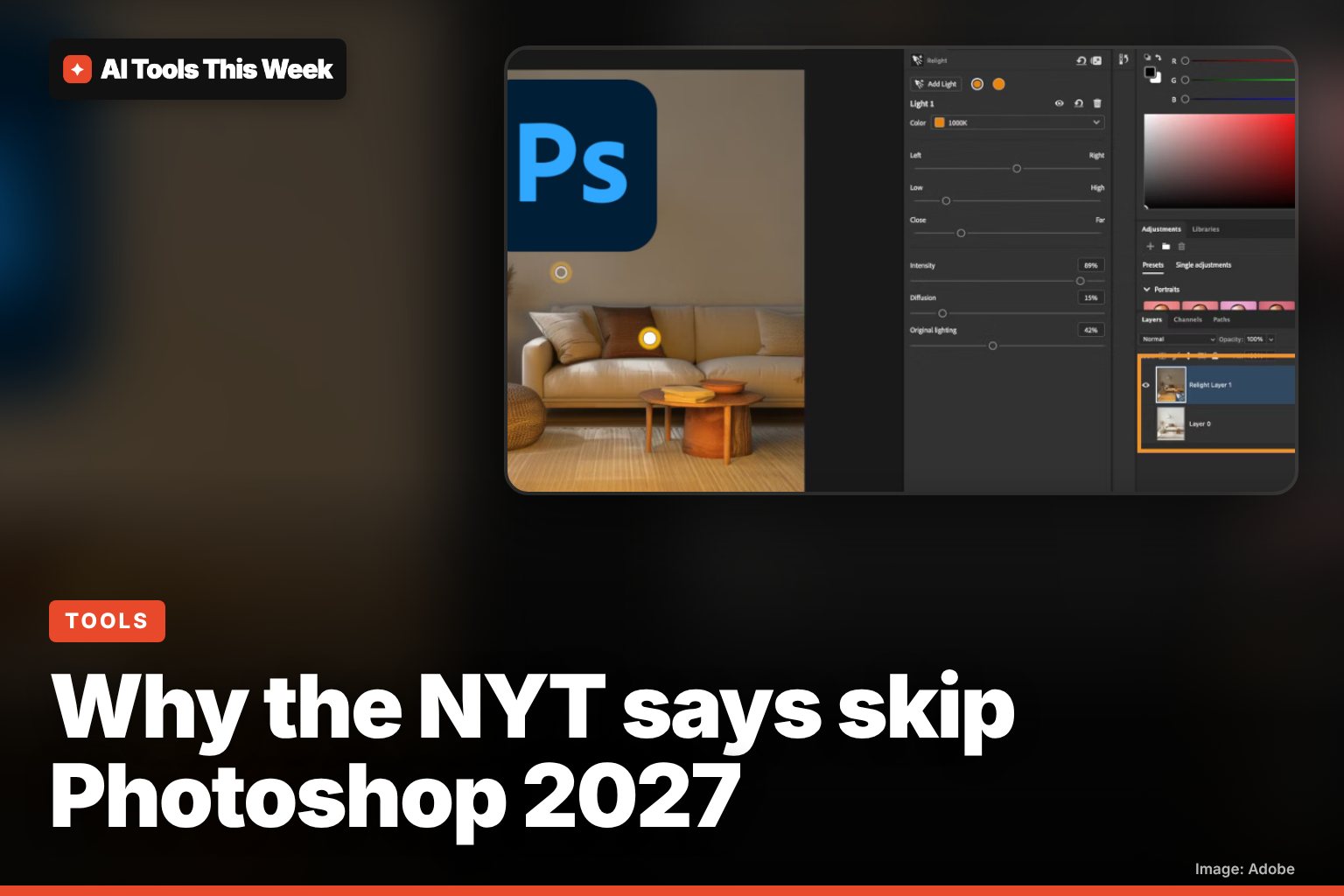
- Photoshop 28.0 came out on November 10, 2026 with new AI tools such as Relight, Remove related elements and Generative Restyle, most of which run online and use generative credits.
The New York Times has told its freelance photographers not to use Adobe Photoshop 2027 (version 28.0.0 and any later update) when working for the paper, because some of its AI features can quietly add metadata that labels a photo as AI-generated. The Times confirmed the rule on November 24, 2026, after an email from two of its photography leaders, Meaghan Looram and Josh Haner, was reported by The Verge and shared on Threads.
The story hit the front page of Hacker News with more than 200 points, and plenty of photographers are now asking whether they should skip the update too. Here is what happened and what it means if you edit photos.
What the Times email says
According to The Verge, the email gives two reasons:
- Photoshop 2027 uses generative AI "in ways that may not be apparent to users".
- Using those features "can result in metadata identifying photographs as AI-generated".
It then says that, for now, all contributing photographers must avoid Photoshop 2027, release 28.0.0 and later, on Times assignments. A Times spokesperson, Graham James, confirmed the requirement. The Times has said before that it does not retouch or digitally manipulate news photos and only makes minimal color adjustments so the image looks accurate.
Neither the email nor the spokesperson said exactly which tools cause the problem, and Adobe had not commented at the time of The Verge's report.
What is new in Photoshop 2027
Adobe released Photoshop 28.0, also called the November 2026 release, on November 10, 2026. CG Channel lists the main AI changes:
| Feature | What it does | Generative credits |
|---|---|---|
| Relight | Detects the light in a photo and lets you change it or add up to three new light sources | 30 per generation |
| Remove related elements | Removes an object plus its shadows, reflections and other traces | 10 |
| Generative Restyle | Turns a prompt-based edit into a separate layer with an intensity slider | 80 per slider |
| Generative Upscale (Firefly Upscaler 2) | Enlarges images with a new AI model | 10 up to 25MP, 20 up to 67MP |
The release also expands the AI Assisted Editor, a view that gathers Photoshop's AI tools into one toolbar and lets you edit with text prompts, and Prompt to edit in the standard Pro Editor. Most of these run online. Non-AI additions include Quick Compare (before/after view) and better text styling.
The Verge points out that it is not always clear which tools count as AI. Even some older options, like automatic selection tools, may now fall under Adobe's AI features, so a photographer might trigger an AI label without meaning to.
Why metadata matters
In August 2026, according to The Verge, Adobe began rolling out C2PA metadata, better known as Content Credentials, across its apps. It records how an image was made and edited, including whether AI tools were used. The Content Credentials standard is run by the Coalition for Content Provenance and Authenticity (C2PA) and backed by companies including Adobe, Microsoft, Google, OpenAI, Meta, Sony and the BBC.
For most people that label is useful: it helps spot fake images. For a newsroom, it cuts the other way. If a real news photo carries a tag saying it was edited with generative AI, readers may assume it was faked, even if the AI only touched up a shadow. That is the trust risk the Times wants to avoid.
What it means for you
- Casual users: nothing changes. Photoshop 2027 works as normal, and AI labels on a holiday photo do not matter much.
- Photojournalists and anyone who must prove a photo is real: check your client's rules before updating. Learn which tools in your workflow use generative AI, and check what Content Credentials your exported files carry before you send them.
- Watch the cost: many of the new tools use generative credits. CG Channel reports that a single-app Photoshop plan includes 25 credits a month, so one Relight (30 credits) already goes over that.
If you want to see how other apps handle this, read how to turn off AI features in Canva, our look at Adobe's AI assistant, and how TikTok's AI checker detects AI likenesses.
We will update this page if Adobe responds, names the features involved, or the Times changes its rule.
AI Tools This Week is not affiliated with Adobe or The New York Times.
Frequently asked questions
Why did the New York Times ban Photoshop 2027?
Because some AI features in Photoshop 2027 are not obviously AI, and using them can write metadata that marks a photo as AI-generated or AI-edited. The Times only allows minimal color adjustments to news photos, so a label like that could make readers doubt real pictures.
Is Photoshop 2027 the same as Photoshop 28.0?
Yes. Adobe's November 2026 release is version 28.0, which the Times email calls Photoshop 2027. The rule covers 28.0.0 and every later update.
Does this affect regular Photoshop users?
Not directly. The rule only applies to photographers on New York Times assignments. But if you need to prove your photos are not AI-made, it is a good reason to check which tools you use and what Content Credentials your exports carry.
Sources
- The New York Times warns photographers not to update Photoshop over AI features (The Verge, Nov 24, 2026)
- Adobe releases Photoshop 28.0 (CG Channel, Nov 10, 2026)
- New York Times requests its freelancers to skip Photoshop's latest AI-filled update (The A.V. Club, Nov 24, 2026)
- Content Credentials (C2PA project site)
Related
Adobe AI Assistant: what it is and is it free? (Nov 2026)
Adobe's AI Assistant does multi-step edits in Photoshop, Premiere, Illustrator and Firefly from a chat. Which apps have it, what's beta and what it costs.
Kandinsky ImageSR 2.0: free AI image upscaler, how to try it
Kandinsky ImageSR 2.0 is a free, MIT-licensed AI upscaler that sharpens photos or enlarges them 2x or 4x. Try the free web demo or run it with ComfyUI.

ChatGPT preinstalled on Lenovo PCs: the $100 Business credit explained
Select Lenovo Windows 11 PCs ship with ChatGPT. Businesses get $100 a seat (new) or $100 total (existing) in credits that expire after 60 days.