
LingSante-3.1-flash: Ant Group's free medical AI model explained
LingSante-3.1-flash is a free, MIT-licensed 560B medical AI model from Ant Group's inclusionAI with a 1M-token context. What it does and who can run it.
Checked and updated 29 November 2026 at 03:40 UTC
Key points
- LingSante-3.1-flash is an open-weight medical AI model from inclusionAI, Ant Group's AI lab, built on Ling-3.1-flash and released on Hugging Face under the MIT license in November 2026.
- It is a mixture-of-experts model with 560 billion total parameters, 25 billion active per token and a 1-million-token context window.
- The weights are free, but running it needs data-center hardware (the official recipe uses 8 Nvidia H200 GPUs). inclusionAI says it is for research and is not a medical device.
LingSante-3.1-flash is a free, open-weight medical AI model from inclusionAI, the AI lab of Ant Group. It has 560 billion parameters (25 billion active at a time), reads up to 1 million tokens at once and is released under the permissive MIT license on Hugging Face. It is aimed at researchers and health-tech developers, and its makers say plainly that it is not a medical device.
What LingSante-3.1-flash is
LingSante is a medical version of Ling-3.1-flash, inclusionAI's general-purpose model (listed on OpenRouter since October 2, 2026). According to the model card, the team trained it on a mix of general and medical data at every stage, then used reinforcement learning to improve medical reasoning, tool use, search and "professional behavior", and finally merged several specialist "teacher" models into one.
inclusionAI highlights three skills:
- Complex medical reasoning: weighing evidence and spotting conflicts between sources.
- Long medical tasks: multi-step workflows that combine searching, tools and changing plans.
- Professional behavior: answers that fit real clinical situations, where information is often incomplete.
The specs in plain English
| Spec | Value | What it means |
|---|---|---|
| Total parameters | 560B | Very large, similar class to big open models |
| Active per token | 25B | Only a slice runs per word, which keeps it faster and cheaper |
| Context window | 1M tokens | Can take in very long records or many papers at once |
| Architecture | Hybrid-linear mixture of experts | 512 experts, 8 used per token |
| License | MIT | Free for commercial and research use |
The Hugging Face repo was created on November 19, 2026. It sits alongside a smaller sibling, LingSante-3.1-air-VL, which also reads images such as scans or lab photos, plus compressed MXFP4 versions of both.
How good is it?
inclusionAI's own claim is that LingSante-3.1-flash scores 45.064 on the InclusionMed medical benchmark, fifth out of 23 model setups tested, while costing less to run than most models above it. Note that InclusionMed is a benchmark run by the same organization, so treat the ranking as a starting point until independent tests appear.
Can you use it?
- Download: free on Hugging Face and ModelScope.
- Run it yourself: the official recipe uses SGLang on 8 Nvidia H200 GPUs (or 4 GB300s), with vLLM as an alternative. That is a server rack, not a laptop. For the difference between models you can run at home and cloud models, see our guide to on-device vs cloud AI.
- API: the model card links to a hosted API on Ant's Computrix platform. On OpenRouter, the smaller LingSante-3.1-air-VL is listed at $0.06 per million input tokens and $0.18 per million output tokens; the flash model was not listed there when we checked.
Downloading big open models has risks of its own, so stick to the official inclusionAI repo (see what happened with malicious GGUF files on Hugging Face).
What it means for you
For most people, LingSante won't show up as an app you can open. Its importance is that a strong medical model is now free for hospitals, startups and researchers to build on and test, which tends to bring prices down for health AI tools. It also shows the trend of general AI assistants adding health features, like ChatGPT's health reminders. Whatever tool you use, AI health answers are a second opinion at most.
AI Tools This Week is not affiliated with Ant Group or inclusionAI. This article is not medical advice.
Frequently asked questions
Is LingSante-3.1-flash free?
The model weights are free to download under the MIT license on Hugging Face and ModelScope. Running it yourself is not cheap, though: the recommended setup is 8 Nvidia H200 GPUs. inclusionAI also links a paid API on its Computrix platform.
Can I use LingSante to diagnose myself?
No. inclusionAI says the model is for research and evaluation, is not a medical device, and must not be used on its own for diagnosis, prescriptions or treatment. Talk to a doctor about symptoms.
Can I run LingSante-3.1-flash on my PC?
Not realistically. With 560 billion parameters it needs multiple data-center GPUs; inclusionAI's quickstart targets 8x H200 or 4x GB300 servers. There is an MXFP4 version that is smaller, but it is still far beyond a home computer.
Sources
Related

Nvidia Nemotron Labs Image: what it is and is it free?
Nemotron-Labs-Image-30B-A3B is Nvidia's open image generator (30B, 3B active). Free to download for research only, and it needs four H100 GPUs.
ERNIE 5.5 Flash Preview: Baidu's free open AI model explained
Baidu's ERNIE 5.5 Flash Preview is a 280B open model (14B active) with a 1M-token context. Free on OpenRouter, weights under Apache 2.0.
Ternary Bonsai 2.5 27B: what it is and is it free?
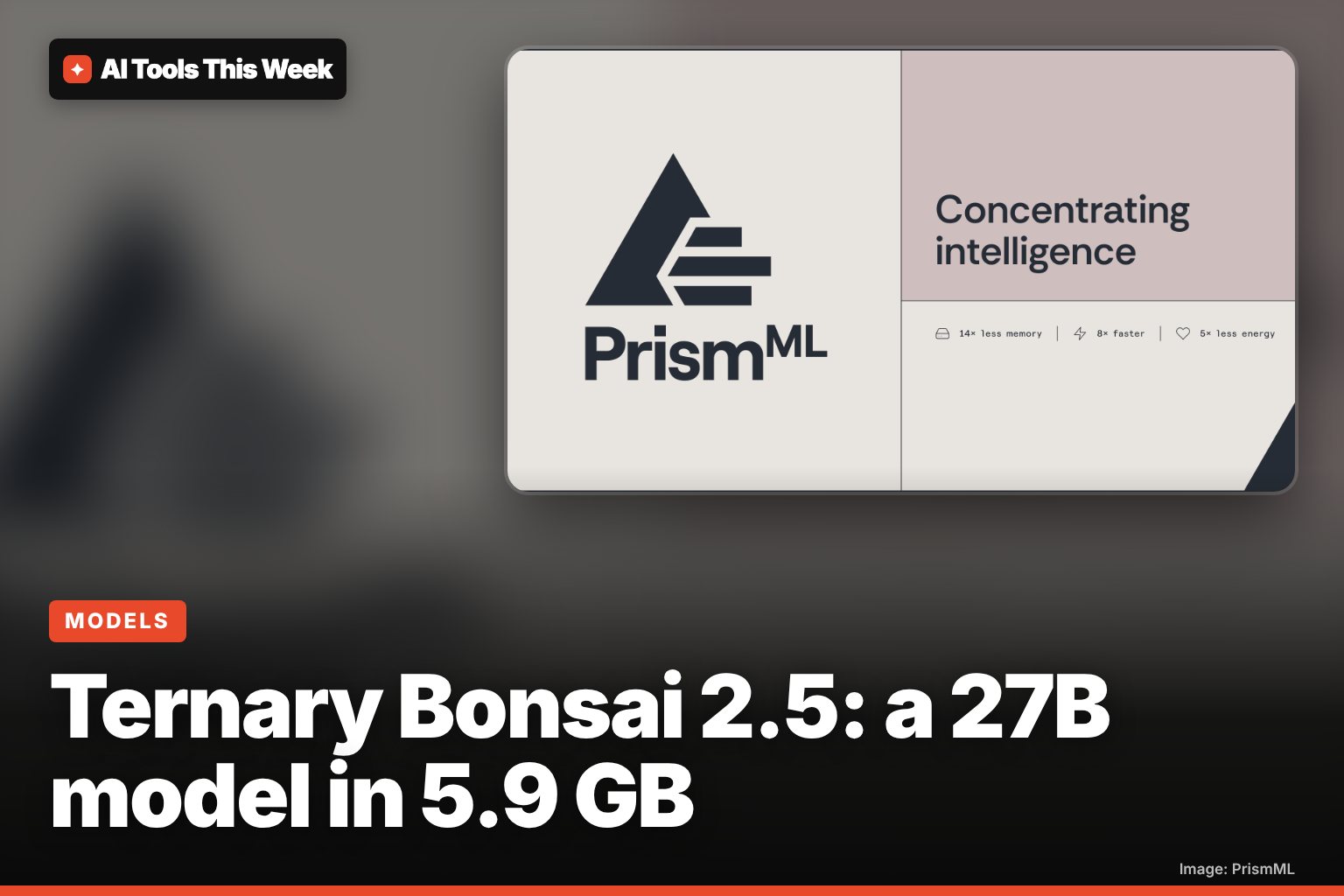
PrismML's Ternary Bonsai 2.5 squeezes a 27B Qwen3.8 model into 5.93 GB with near-full tool-calling scores. Free under Apache 2.0, runs on a GPU or Mac.