
Microsoft Decision 1.1: what it is, price and what's new
Microsoft Decision 1.1 scores fixed answers instead of writing text. GA since Nov 17, 2026, now reads images, $0.042 per million input tokens.
Checked and updated 29 November 2026 at 03:40 UTC
Key points
- Microsoft Decision 1.1 is an AI model that picks between answers you give it (yes/no, a category, a score) and returns a probability for each, instead of writing a reply.
- It became generally available on November 17, 2026, adds image input (up to 8 per call) and moves from Qwen3.5-9B to Google's Gemma 4 26B-A4B as its base.
- It costs $0.042 per million input tokens on Azure's Global Standard tier, and output is free. It is built for developers, not for chatting.
Microsoft Decision 1.1 is an AI model that doesn't write answers: you give it a question and a fixed set of options, and it returns a calibrated probability for each one. It became generally available on November 17, 2026, now reads images as well as text, and costs $0.042 per million input tokens with free output. It is a developer tool for apps and AI agents, not something you chat with.
What Decision 1.1 actually does
Most AI models produce text, and an app then has to read that text to work out what the model "decided". Microsoft's Decision models skip that step. According to the Microsoft Foundry model card, Decision 1.1 handles:
- Yes/no questions ("Was a refund issued?")
- Multiple choice and classification ("Which team should handle this ticket?")
- Ratings and rubric scores ("How well does this answer follow the policy?")
- An explicit "cannot tell" option when the input doesn't contain enough evidence
The output is JSON with a choice, a confidence value and a probability for every option, all in one call. An app can then set its own threshold, for example act automatically above 0.9 and send everything else to a human.
What's new compared with Decision 1
Decision 1 launched in preview on October 9, 2026, as a text-only model post-trained from Qwen3.5-9B. Version 1.1 changes three things:
| Decision 1 | Decision 1.1 | |
|---|---|---|
| Base model | Qwen3.5-9B | Gemma 4 26B-A4B (Google, open-weight) |
| Input | Text | Text + up to 8 images (PNG or JPG) |
| Context | n/a | 32,767 tokens |
| Status | Preview (Oct 9) | Generally available (Nov 17) |
| Price (Global Standard) | $0.042 / 1M input | $0.042 / 1M input |
Microsoft says 1.1 is more than twice as fast at the same cost. Treat that as Microsoft's claim: Classmethod, a Japanese cloud consultancy that tested both versions on November 18, measured a median of 1,020 ms for 1.1 versus 1,093 ms for 1.0 from a laptop, so network overhead may hide most of the gain. What the tester did see clearly was stability: 1.1 returned exactly the same probabilities in four repeat runs on all 107 test cases.
Price and where to get it
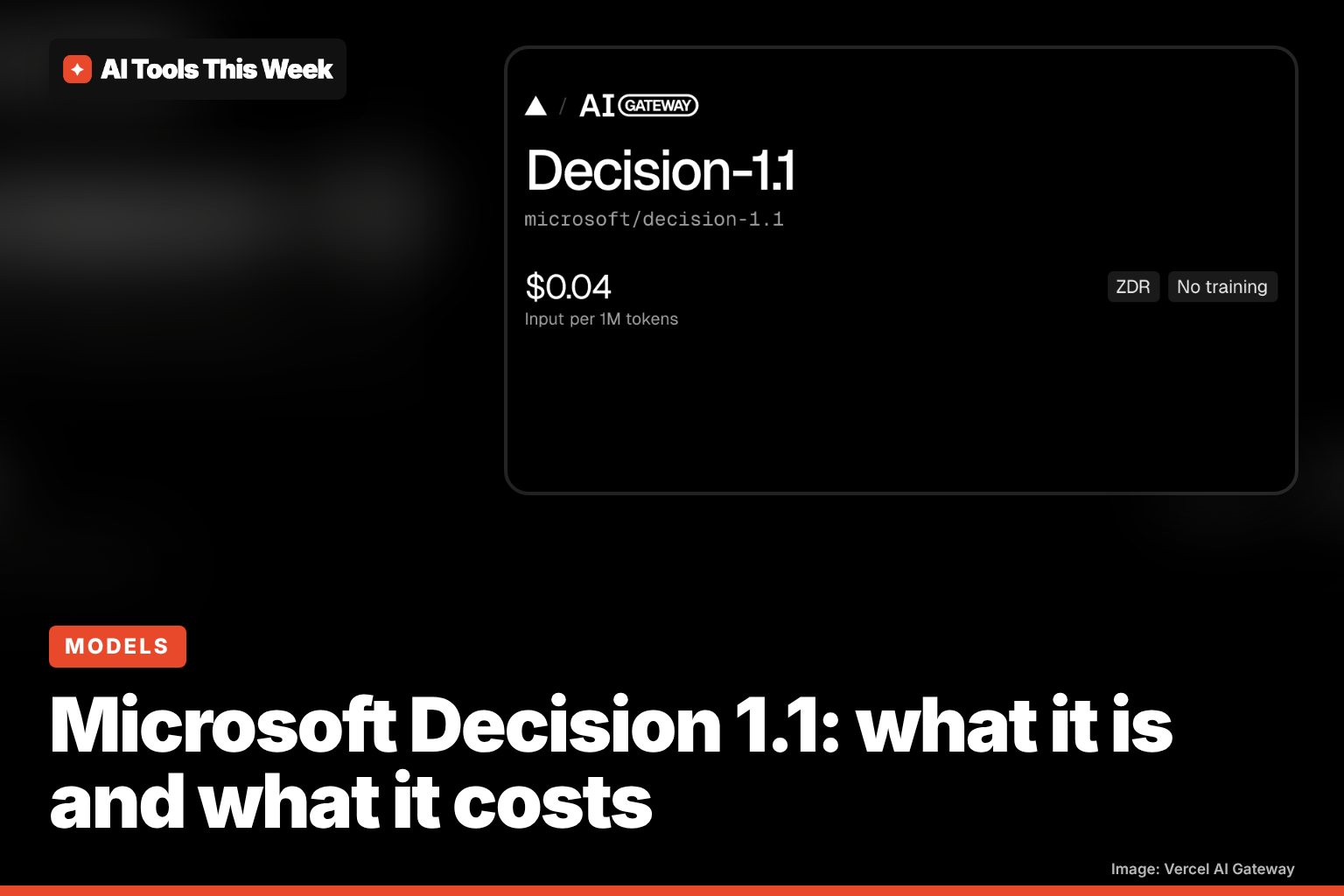
- Microsoft Foundry: deploy "Microsoft-Decision-1.1" as a base model. Global Standard is $0.042 per million input tokens, Data Zone Standard is $0.046 (US) and $0.05 (EU/APAC). Output tokens are free.
- Vercel AI Gateway: model ID
microsoft/decision-1.1, also listed at $0.042 per million input tokens, with adecide()helper in Vercel's AI SDK.
At those prices, a short classification request of under 100 tokens costs a tiny fraction of a cent, which is the point: Microsoft wants routine routing and approval checks moved off expensive chat models.
What it is good for, and what it isn't
Microsoft lists evaluating AI answers against a rubric, checking whether an answer is grounded in supplied evidence, routing and triage, guardrails that check an agent's proposed action before it runs, content-safety screening and search relevance.
It is not for open-ended questions, chat, translation or summaries, and Microsoft says it should never be the only decision-maker in choices about people such as credit, jobs, housing, insurance or healthcare. It also gives no explanation for its scores, and Microsoft's documentation warns that results can shift with how a question is worded. Analysts quoted by InfoWorld at the Decision 1 launch recommended starting with reversible tasks and keeping humans in the loop for anything high-impact.
How it compares with Google's version
Google sells a similar idea through its own Decisions API (see our guide to Gemini's Decisions API). In Classmethod's small image test, Decision 1.1 found 17 of 20 planted errors, the same as Google's Decisions API, but raised more false alarms (18 versus 7) while using far fewer input tokens. One test isn't a verdict, but it shows these models trade accuracy, false positives and cost differently.
What it means for you
If you only use ChatGPT or Copilot, nothing changes on your screen. But models like this are what make AI agents cheaper and safer to run: a small, fast "judge" checks each step before a larger model or an agent acts. If you want the bigger picture, start with what an AI agent is and how companies like Google set rules for AI agents at work.
AI Tools This Week is not affiliated with Microsoft or Vercel.
Frequently asked questions
Is Microsoft Decision 1.1 free?
No, but it is very cheap. Azure lists $0.042 per million input tokens on Global Standard ($0.046 Data Zone US, $0.05 Data Zone EU/APAC) and charges nothing for output. There is no free consumer app: you use it through Microsoft Foundry or a gateway such as Vercel AI Gateway.
Can I chat with Microsoft Decision 1.1 like ChatGPT?
No. Microsoft says it is not designed for text generation, conversation, translation or summaries. It only answers closed questions with options you define, and it does not explain its reasoning.
What is the difference between Decision 1 and Decision 1.1?
Decision 1.1 accepts images as well as text, is built on Gemma 4 26B-A4B instead of Qwen3.5-9B, and Microsoft says it is more than twice as fast at the same price. One independent tester saw nearly identical client-side speed but much more stable scores across repeated runs.
Sources
Related
MAI Image 2.7: Microsoft's new image AI, and how to try it free
MAI Image 2.7 and 2.7 Flash (Nov 17, 2026) are Microsoft's new image models. Try them free in MAI Labs; developers pay about $35 or $10 per 1,000 images.

GPT-6.2 Astra solves a 1808 sketchbook mystery: what happened
Historian Mark Humphries says GPT-6.2 Astra identified the artist of an unsigned 1808 Yale sketchbook in 22 minutes. How it worked and the caveats.
LingSante-3.1-flash: Ant Group's free medical AI model explained
LingSante-3.1-flash is a free, MIT-licensed 560B medical AI model from Ant Group's inclusionAI with a 1M-token context. What it does and who can run it.