
What is claude-mem, and is it free? Memory for AI agents
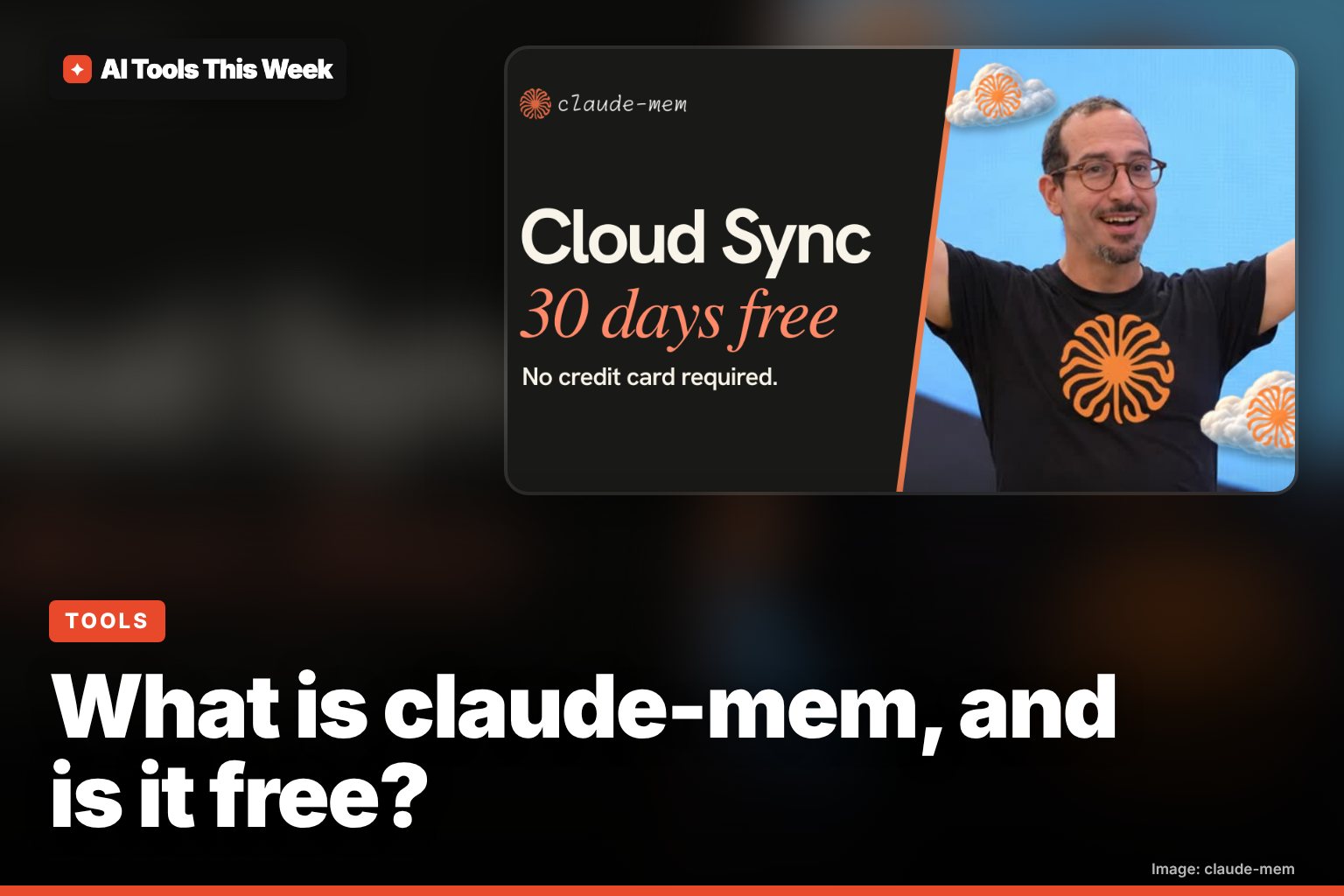
Claude-mem is a free, open-source (Apache 2.0) memory plugin for Claude Code and other agents. Cloud Sync is optional: 30 days free, then $12/month.
Checked and updated 27 November 2026 at 03:40 UTC
Key points
- Claude-mem gives coding agents like Claude Code a long-term memory: it saves decisions, fixes and discoveries from your sessions into a local database and feeds the useful bits back into the next session.
- The core engine is free and open source under the Apache 2.0 license. Your model provider's usage may cost money depending on how you set it up.
- The paid extras are optional: Cloud Sync ($12/month or $99/year, with a 30-day free trial and no card) and hosted memory generation from $30/month.
Claude-mem is a free, open-source plugin that gives AI coding agents a memory that lasts between sessions. It watches what your agent does in Claude Code (and other tools), saves the useful parts such as decisions, bug fixes and discoveries to a database on your computer, and brings that context back the next time you start work.
The engine costs nothing and is licensed under Apache 2.0. This week its Cloud Sync add-on is featured on Product Hunt: a paid option that carries that memory between your devices, which is why the name is everywhere right now.
What problem it solves
Every new Claude Code session starts from zero. The agent doesn't remember why you picked a library yesterday, which test fixture to use, or the bug it already fixed twice. Claude-mem fills that gap:
- Capture: supported integrations record observations and session summaries while you work.
- Store: everything goes into a local SQLite database on your machine.
- Recall: you can search by keyword, follow a timeline, and open the original note. A semantic search adds another way to find things when its vector index is on.
- Move it: you can export chosen memories to JSON and import them into another claude-mem install, with duplicates skipped.
The project's site points to a published case study where one user ran it on three machines for 70 days and logged 22,718 observations, 1,262 bug fixes and 757 decisions. The homepage shows about 120k GitHub stars.
Is it free? The plans
| Plan | Price | What you get |
|---|---|---|
| Open source claude-mem | Free | Local memory on your machine, search, session history, bundled skills |
| Cloud Sync | $12/month or $99/year | Your memory on all your connected devices, remote Work View, private MCP recall. 30-day free trial, no card (monthly only) |
| Hosted tokens: Pro | $30/month | $30 of memory-generation allowance |
| Hosted tokens: Heavy | $70/month | $49 allowance |
| Hosted tokens: CMEM Max | $100/month | $70 allowance |
Two catches. First, writing the memories takes model calls, and the pricing page says your provider's usage "may have a separate cost" depending on your setup. Second, the hosted-token plans bill from day one with no trial, and they are separate from Cloud Sync. If you skip adding a card during the Cloud Sync trial, it simply ends and your local memory stays on your computer. A shared team version, TeamBrain, is still in a design-partner stage with no public price.
How to install it in Claude Code
- Check you have Node.js 20.19+ (or 22.12+) and Claude Code 2.1.139 or later. Older Claude Code versions ignore the hook arguments and nothing gets saved. Run
claude updateif needed. - In a terminal, run
npx claude-mem install. It installs Bun and uv if they're missing, sets up the hooks and opens a browser page where you pick your agents, skills, and local memory or the Cloud Sync trial. - Or, inside Claude Code, run
/plugin marketplace add thedotmack/claude-memand then/plugin install claude-mem. The first session after a marketplace install may run without memory while the launcher builds. - Start a new Claude Code session. Context from earlier sessions loads on its own.
Don't run npm install -g claude-mem: the docs warn that it installs only the library and doesn't register the hooks.
Which tools it works with
Besides Claude Code, the docs list Cursor, Codex CLI, Gemini CLI, Windsurf, OpenCode, Antigravity CLI, OpenClaw and Grok Bot, plus agent frameworks such as LangGraph, CrewAI, the OpenAI Agents SDK and the Claude Agent SDK. You can also run the memory writer on local models through Ollama or LM Studio.
Should you use it?
If you use Claude Code daily on the same projects, the free local version is an easy experiment: nothing leaves your machine unless you choose Cloud Sync. If you only chat with Claude in the app, claude-mem isn't built for you: it hooks into coding agents, not the chat app. New to agents? Start with what an AI agent is, see how Claude Ship handles app building, or compare it with another open-source agent, Hermes Agent.
AI Tools This Week is not affiliated with claude-mem or Anthropic.
Frequently asked questions
Is claude-mem free?
Yes, the open-source engine is free (Apache 2.0) and stores memory on your own machine. You only pay if you add Cloud Sync, which is $12 a month or $99 a year after a 30-day free trial with no card, or the hosted-token plans that start at $30 a month. Model usage through your own provider may cost extra.
How do I install claude-mem in Claude Code?
Run npx claude-mem install in a terminal, or inside Claude Code type /plugin marketplace add thedotmack/claude-mem and then /plugin install claude-mem. Don't use npm install -g claude-mem: that installs only the library and doesn't hook into Claude Code.
Is claude-mem made by Anthropic?
No. It's an independent open-source project by the developer thedotmack and contributors. It works with Claude Code and also with other agents such as Cursor, Codex CLI, Gemini CLI, Windsurf and OpenCode.
Sources
Related
Kandinsky ImageSR 2.0: free AI image upscaler, how to try it
Kandinsky ImageSR 2.0 is a free, MIT-licensed AI upscaler that sharpens photos or enlarges them 2x or 4x. Try the free web demo or run it with ComfyUI.
What is Magnitude? Free app that runs big AI models on your PC
Magnitude is a free, open-source (Apache 2.0) app that runs 66–249 GB AI models on normal PCs and Macs by streaming parts from your SSD. Speeds and setup.
What is OCRia-nano-1, and is it free? LlamaIndex's CPU OCR
OCRia-nano-1 is an 8.1M-parameter LlamaIndex OCR model that turns PDFs into Markdown on a CPU. Free for personal use; big firms need a licence.