
Donald Knuth stops reading error reports after AI flood
Since Nov 25, 2026, Donald Knuth won't read new error reports for his books: LLM-made reports, mostly repeats, outpaced him. What it means.
Checked and updated 28 November 2026 at 21:40 UTC
Key points
- Computer scientist Donald Knuth has paused his famous error reports: anything submitted after November 25, 2026 won't be read until he posts an updated list of known errors for that book.
- His reason: LLMs made readers so 'productive' that reports now arrive faster than he can read them, and random sampling shows most recent reports repeat issues others already sent.
- Knuth has paid readers for errors since the 1960s; his Bank of San Serriffe pays 0x$1, or $2.56, per find. No book is accepting new reports right now.
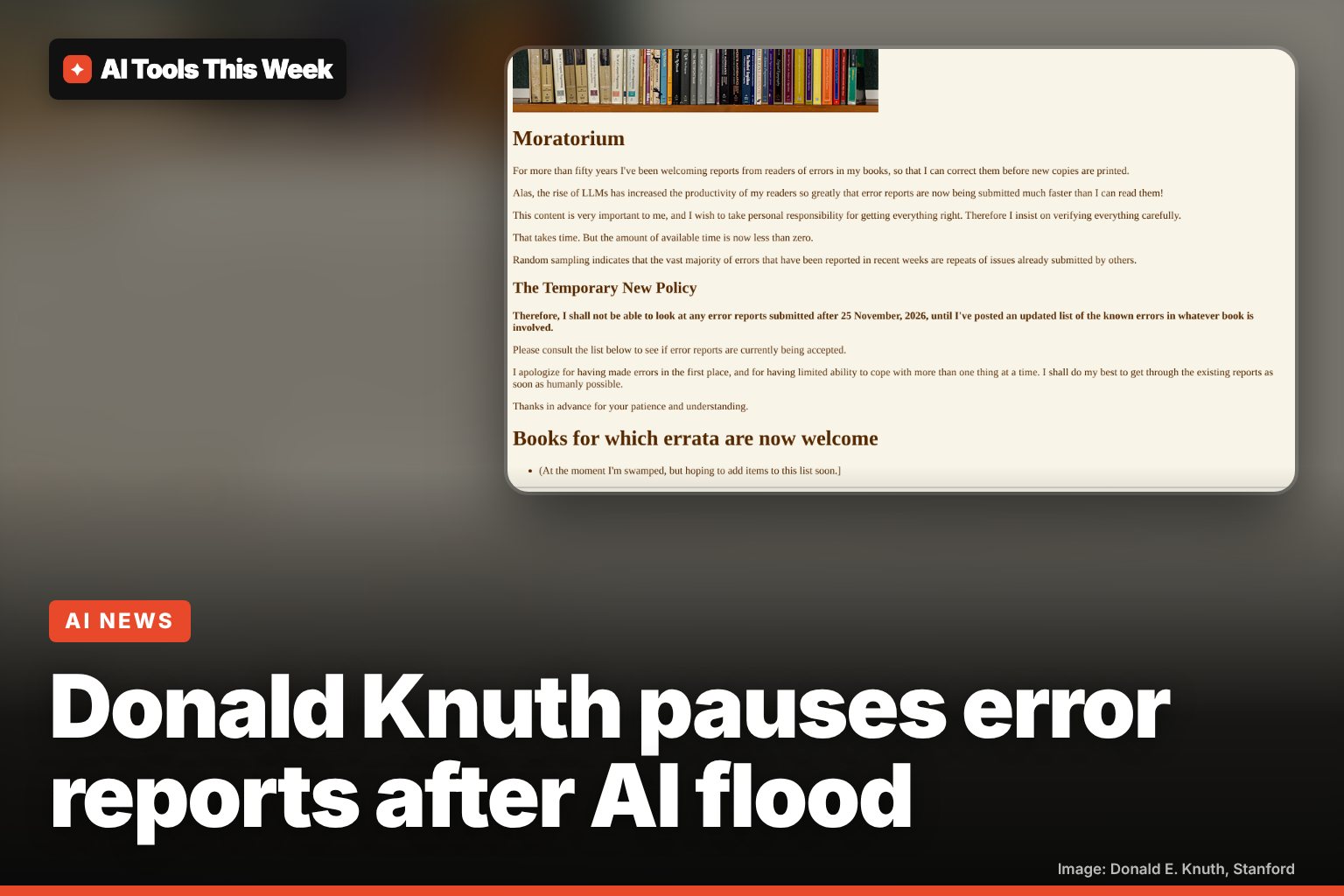
Donald Knuth, author of The Art of Computer Programming, has stopped reading new error reports for his books because AI tools made them pile up faster than he can check them. Any report sent after November 25, 2026 won't be looked at until he posts an updated list of known errors for that book, and right now no book is open for reports. The note, posted on his Stanford site, is one of the top stories on Hacker News today.
What Knuth said
Knuth has welcomed readers' error reports for more than fifty years so he can fix mistakes before new printings. On his new "Moratorium" page he explains, in his usual dry style, that LLMs have raised his readers' productivity so much that reports now arrive "much faster than I can read them", and that his available time "is now less than zero."
Two details matter:
- Most of the new reports are repeats. Random sampling showed the vast majority of recent reports were issues other readers had already sent.
- He checks everything himself. Knuth insists on verifying each report personally, so a flood of duplicates blocks the real ones.
His "Recent News" page puts it shorter: "Help, I'm drowning!"
The rules now
| Report sent | What happens |
|---|---|
| On or before Nov 25, 2026 | Still in his queue; he says he'll work through them as fast as he can |
| After Nov 25, 2026 | Not read until he posts an updated errata list for that book |
| Books open for new reports | None at the moment ("I'm swamped") |
Knuth says he will add books back to a "now welcome" list on the same page, so that is the page to check before sending anything.
The famous $2.56 checks
Knuth's reward checks are a computing legend. His "Bank of San Serriffe" lists every reader's balance in hexadecimal dollars, with a par value of 0x$1, which is $2.56. The listed balances only cover errors reported since 2006; he notes that many more checks went out between 1968 and 2005. Amusingly, the current list includes an entry for "Claude c/o Ralph Furman".
Why this matters beyond one author
Knuth isn't anti-AI. His news page says AI "greatly surprised" him for the first time this year in his note "Claude's Cycles". The problem is volume: when anyone can ask a chatbot to scan a long book for mistakes, many people get the same few findings and all send them, and a careful human reviewer becomes the bottleneck.
If you use AI to find mistakes in someone's work, a few habits help:
- Check the existing errata or issue list first. Most of Knuth's duplicates would have been caught this way.
- Verify the error yourself before sending it. Chatbots can be confidently wrong, as the debate over whether AI solved P vs NP shows.
- Send one clear report, not a batch of everything the model flagged.
For more on how AI is changing research and proofs, see what a Lean proof checker is and Anthropic's Riemann hypothesis claims.
AI Tools This Week is not affiliated with Donald Knuth or Stanford University.
Frequently asked questions
Why did Donald Knuth stop accepting error reports?
Because of AI. Knuth wrote that the rise of LLMs increased readers' productivity so much that reports now come in faster than he can read them, and that most recent ones repeat errors others already reported. He insists on checking every report himself, so he paused new ones.
Does Knuth still pay $2.56 for errors?
The reward system still exists: his Bank of San Serriffe lists balances in hexadecimal dollars, with par value 0x$1 = $2.56. But reports sent after November 25, 2026 won't be looked at until he publishes an updated errata list for the book, and no book is open for new reports yet.
Is Knuth against AI?
Not exactly. His news page says AI 'greatly surprised' him for the first time this year, in his note 'Claude's Cycles', and the bank page even lists a reward for 'Claude c/o Ralph Furman'. The moratorium is about the volume of duplicate reports, not about AI as a tool.
Sources
Related

UC ChatGPT Edu deal: free ChatGPT for UC students from Dec 1
The University of California is paying OpenAI $1.2M a year so all 10 campuses get free ChatGPT Edu and Codex from Dec 1. What students get and the limits.
California AI kill switch plan: what the Nov 2026 report proposes
California's Nov 18 AI safety report proposes emergency shutdown power, 48-hour incident reports, licensed auditors and a cap on self-improving AI.

Google AI in schools: off by default, but Search comes with AI
Google is switching Gemini and Search off by default for K-12 student accounts. Schools can turn Search back on, but AI Overviews come with it. Explained.