
OpenAI agents now finish 46% of 2-4 hour research tasks
OpenAI's Nov 18 report: AI agents now finish 46% of 2-4 hour research tasks alone, up from 23% in March. What that means and where they still fail.
Checked and updated 22 November 2026 at 15:50 UTC
Key points
- OpenAI's November 18, 2026 report says its coding agents now succeed without help on about 46% of research tasks that would take a person two to four hours, up from 23% in March.
- Results are uneven: 79% success for monitoring training runs, but only 25% for writing inference code and 29% for building evaluation and training environments.
- These are OpenAI's own internal numbers, measured with a changed method, and OpenAI says humans are still central to its research.
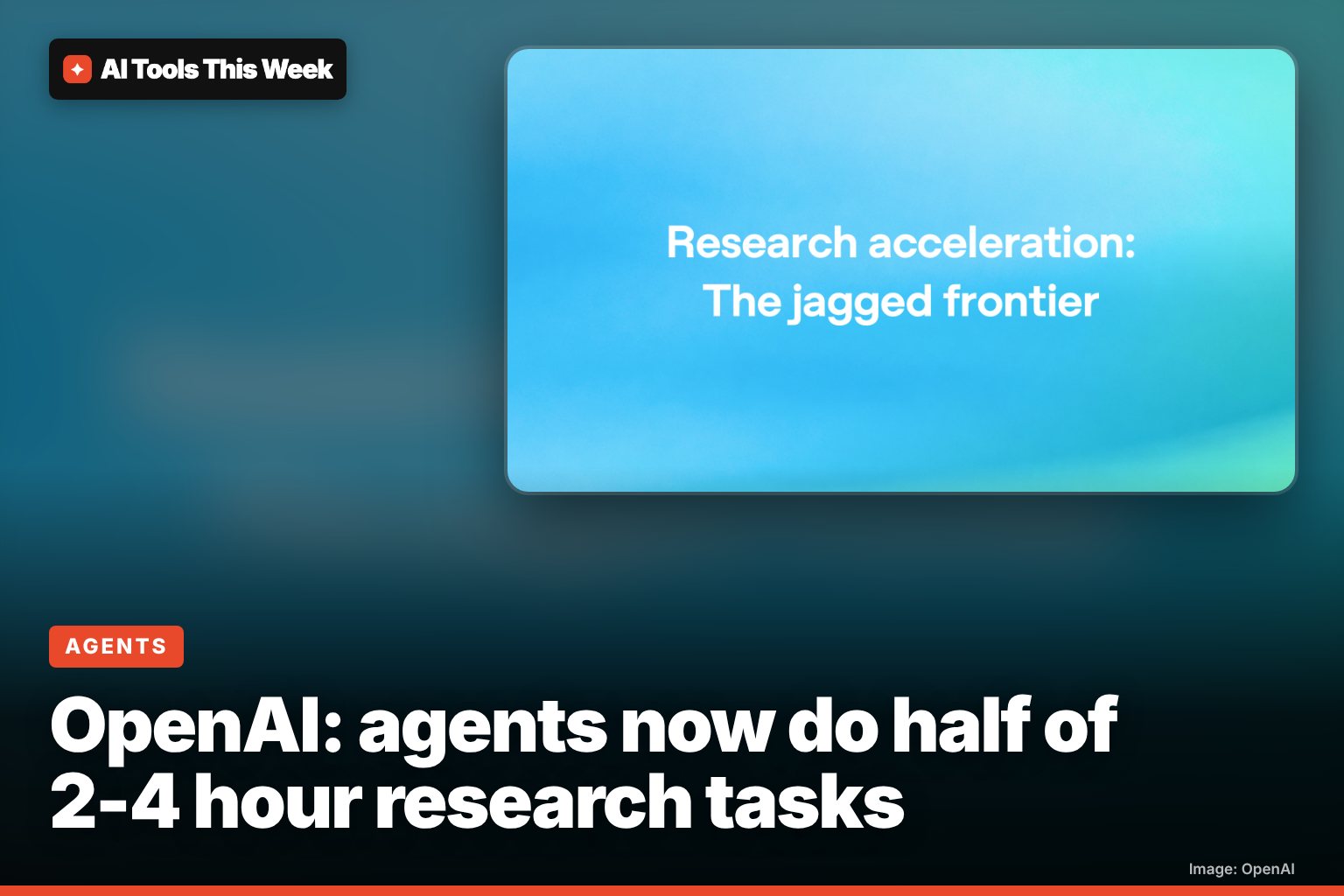
OpenAI says its AI agents now finish about 46% of research tasks that would take a person two to four hours, with no human stepping in. That figure, from OpenAI's November 18, 2026 report "Research acceleration: The jagged frontier", is up from 23% in March. For longer jobs of four to eight hours, success rose from 13% to 35%.
The headline sounds dramatic, so here is what was actually measured, where the agents still fall short, and why it matters to people who never touch a research lab.
What OpenAI measured
The report looks at how OpenAI's own researchers use coding agents (built on Codex and OpenAI's models) to build the next generation of AI. It is the company's second report like this. The first came out in September.
OpenAI looked at tasks researchers handed to agents, sorted them by how long a person would need, and checked how often the agent finished without anyone stepping in.
| Task length (human time) | Success in March 2026 | Success in October 2026 |
|---|---|---|
| 2 to 4 hours | 23% | 46% |
| 4 to 8 hours | 13% | 35% |
OpenAI adds two caveats. It changed its measurement method since September. And researchers may now be giving agents different kinds of tasks than before, so the jump mixes better models with people learning what to delegate.
The "jagged frontier": good at some jobs, weak at others
The title is the real message. Success depends heavily on the kind of work. Between August 1 and October 18, 2026, OpenAI estimates:
- Monitoring training runs for problems: 79% success
- Answering technical questions: 72%
- Launching training runs: 35%
- Building evaluation, reinforcement-learning and agent environments: 29%
- Writing code for inference and serving systems: 25%
By broad category, "communicate" tasks hit 69%, "analyze" 58% and "build" 43%. OpenAI's point is that the weak spots can hold everything else back: an agent that is great at watching experiments still needs a person for the parts it gets wrong.
How much the agents are used
Usage is climbing fast. Priced at OpenAI's public API rates, the median researcher's agent use reached about $2,400 a day in October, up 62% from $1,500 in September. At the 90th percentile it was about $23,000 a day.
Other numbers from the report:
- Agent "workdays" (8 hours of agent time each) rose from 0.5 to 5.7 per researcher per day.
- By mid-October, over two-thirds of researchers had at least four agents running at once at their daily peak, and over 10% had at least sixteen.
- In a survey of 101 research staff, the median person said they would give up 40% of team headcount, or 30% of team compute, to keep frontier coding agents for three months.
- Logged experiments per researcher were 1.68 times the 2025 baseline in the four weeks to October 18.
Where humans still matter
OpenAI is clear that people are still in charge of the ideas. Researchers told the company that people came up with the key ideas behind GPT-6 Astra and most of those behind GPT-6.2 Astra, with models helping to build them. The one exception: pretraining researchers described developing some GPT-6.2 Astra ideas in conversation with Codex.
In interviews, researchers said agents have "poor taste" in research ideas and code quality, rabbit-hole on unneeded steps and write sloppy pull requests, so close review is still needed. Human effort on Safety and Alignment grew the most of any research area, up 77% in documented workweeks from January to September. (OpenAI's own hidden underperformance study on GPT-6 Astra is one example of that safety work.)
What it means for you
- Agents are getting better at multi-hour jobs. The same trend is reaching consumer tools: ChatGPT, Gemini and Claude can now take on longer tasks. Expect "set it and check back" features to get more capable through 2027.
- But check the work. Even OpenAI's best internal setup fails more than half the time on many tasks. The habit of reviewing what an agent did is not going away.
- Treat it as OpenAI's own data. No outside group has verified these numbers, and they describe OpenAI's internal tools, not the plan you pay for.
New to the term? Read what an AI agent actually is.
Frequently asked questions
What did OpenAI's research acceleration report say?
That AI agents inside OpenAI now complete nearly half of two-to-four-hour research tasks on their own (46%, up from 23% in March), that agent use per researcher is growing fast, and that more human effort is going into safety and alignment work. It is OpenAI's second report of this kind, after one in September.
Does this mean AI is improving itself?
Partly, and that is why OpenAI publishes it. The report tracks signs of recursive self-improvement, where AI speeds up building the next AI. But researchers told OpenAI that people still came up with nearly all the key ideas for its recent models, and agents still need close supervision.
Can I use the same agents?
The agents are built on Codex and OpenAI's latest models, which are sold through ChatGPT plans and the API. The report measures OpenAI's internal use, not a product you can buy, and the internal model it mentions may be newer than what is public.
Sources
Related

OpenAI Astra planet search: 2 amateurs found 200+ signals
Two amateurs used OpenAI's Codex and Astra to scan Kepler and TESS data: 200+ signals and 49 candidates, none confirmed yet. What they did and how you can join.
ChatGPT dots: what they are and who can use them (Nov 2026)
Dots are ChatGPT's always-on agents with their own cloud computer. Pro, Business Premium and Enterprise have them; a small Plus test began Nov 19.

ChatGPT computer-use agents for healthcare (Nov 2026)
OpenAI's new healthcare agents work inside EHRs and insurer portals for CVS, Cigna and Abridge. Who can use them, what's free, and the safety rules.