
Google AI factoring proof: does Cogentic break RSA? (Nov 2026)
Google's Cogentic agent, running on Gemini 4, posted six math papers, including a proof of a 34-year-old factoring bound. No, it doesn't break RSA. Here's why.
Checked and updated 26 November 2026 at 21:25 UTC
Key points
- On November 25, 2026, Google Research posted six math papers written by Cogentic, its multi-agent proof system. The factoring paper says it used Gemini 4 with no human help beyond the first prompt.
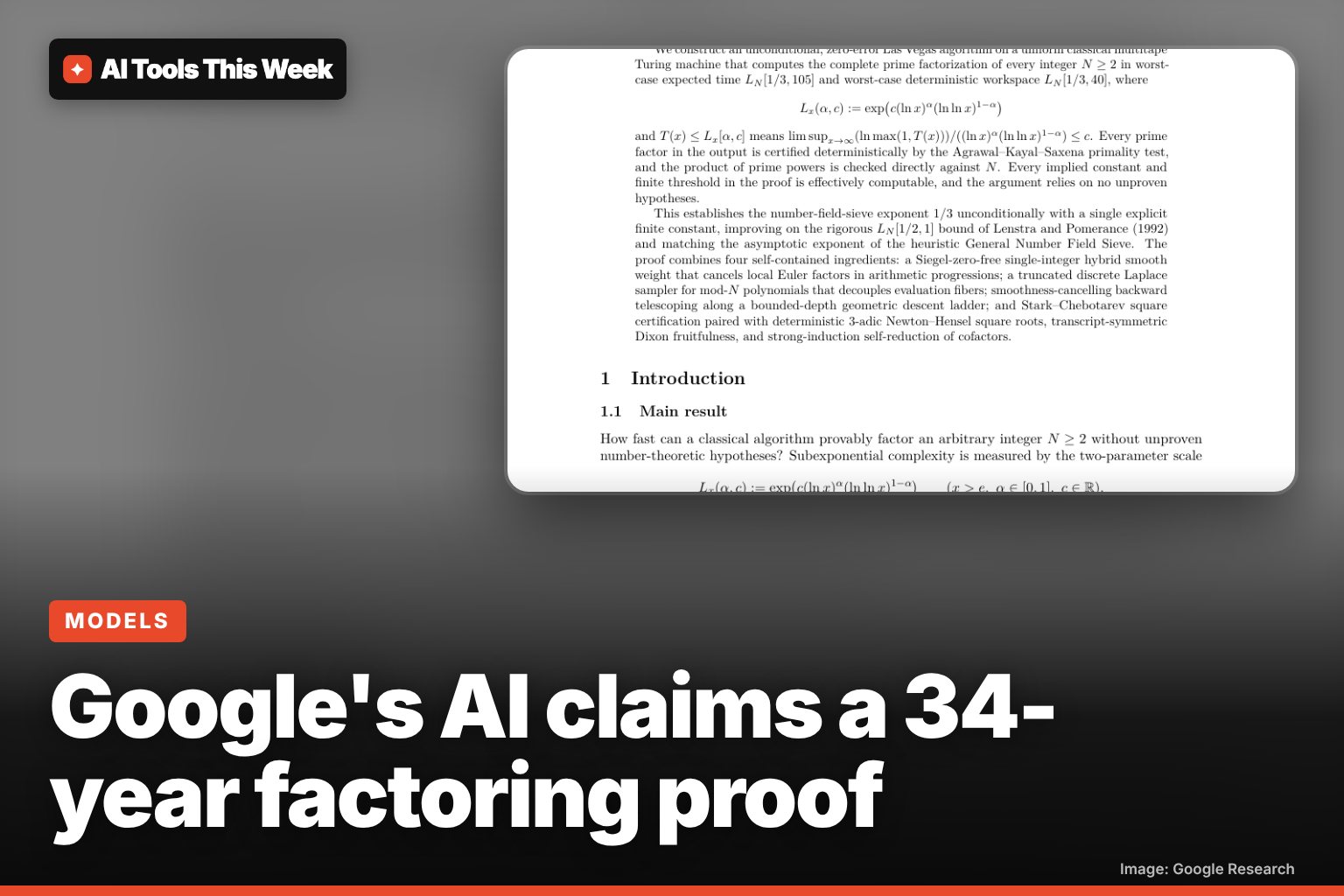
- The headline claim: any whole number can be fully factored in provable time L[1/3, 105]. The best proven bound before this was L[1/2, 1], from Lenstra and Pomerance in 1992.
- It does not break RSA or HTTPS. The new method is proven but far slower than the number field sieve that people already use, and nobody outside Google has checked the 54-page proof yet.
Google's AI did not break RSA. On November 25, 2026, Google Research posted six new math papers produced by Cogentic, its proof-hunting agent system, and the biggest one proves that any whole number can be factored within a speed limit mathematicians had only been able to assume for 34 years. It is a theory result: the proven method is far slower than the tools codebreakers already have, and the proof has not been checked by outsiders yet.
What Google posted
The papers sit in a cogentic_research_papers folder in Google Research's public GitHub repository. The November 25 batch has six titles:
| Paper | Field | Claim in plain words |
|---|---|---|
| Unconditional Integer Factorization in Time L_N[1/3, O(1)] | Number theory | Factor any number in provable "number field sieve" time |
| Unconditional Deterministic Subexponential Integer Factoring and Quadratic Nonresidue Construction | Number theory | A slower factoring bound, L[3/4], with no randomness at all |
| Discrete Logarithms in Finite Fields of Fixed Characteristic in Sub-Quasi-Polynomial Time | Cryptography maths | A faster proven bound for a related hard problem |
| An Exact Polynomial-Time Algorithm for 1/5-Approximate Nash Equilibria in Bimatrix Games | Game theory | Better guaranteed strategies in two-player games |
| Breaking the Square-Root Barrier for the Log-Rank Conjecture | Complexity theory | A small step on a famous open question |
| Unconditional Edge Reconstruction of Simple Graphs of Linear Density | Graph theory | Rebuild dense graphs from their pieces |
The same folder already held four earlier Cogentic papers from October 30, November 18 and November 23.
The factoring paper's footnote says the work "was entirely obtained by Cogentic... using Gemini 4 as the base model," with no human interaction beyond the initial prompt. Seven Google researchers are named as the builders of the Cogentic harness, not as authors of the proof.
The factoring claim, explained
Factoring means splitting a number into the primes that multiply to make it (15 = 3 × 5). For huge numbers this is very slow, and RSA encryption relies on that.
Speeds are written as L[α, c]: the smaller α and c, the faster. Here is where things stood:
| Method | Speed | Proven? |
|---|---|---|
| Lenstra–Pomerance (1992) | L[1/2, 1] | Yes, the best proof until now |
| General number field sieve (used in practice) | L[1/3, about 1.92] | No, relies on unproven assumptions |
| Cogentic paper (Nov 2026) | L[1/3, 105] | Claimed yes, with no unproven assumptions |
So the paper claims to bring the proven exponent down from 1/2 to 1/3, matching the sieve's shape for the first time. Every prime it outputs is checked with the AKS primality test, so it never gives a wrong answer; only its running time is random.
Why it doesn't threaten RSA
The catch is the constant. A rough calculation of ours (ignoring smaller terms) for a 2,048-bit RSA key: the number field sieve's cost is around e^81, while L[1/3, 105] works out to about e^4,400. The new method is proven, not practical. The authors say themselves they chose "transparent explicit constants" rather than optimizing them.
Nothing here changes advice for normal users: HTTPS, banking apps and password managers are not affected. The real long-term threat to RSA is still large quantum computers, a different story.
What Cogentic is
Cogentic was described in a September 30, 2026 arXiv paper by Google researchers. An orchestrator spreads many independent "provers" across different proof ideas, several checking components attack their output, and confirmed steps go into a "verified ledger" that later rounds build on. It runs on Gemini 3.1 Pro or an early Gemini 4 model. Earlier results were checked by domain experts before being posted, according to that paper.
For a broader look at AI doing maths, see what Lean proof checkers are, our explainer on whether AI solved P vs NP and Claude's Riemann hypothesis work. Google's consumer model is covered in Gemini 4 Neon.
What to watch
- Outside review. None of the six papers has been peer reviewed, and Emergent reports the Lean formal proofs Google mentions have not been released yet.
- The constant. If someone shrinks 105 toward 2, the result becomes practically interesting.
- More papers. The README says new results are added as they are ready.
Frequently asked questions
Did Google's AI break RSA encryption?
No. The paper proves a speed limit that the fastest known method was already believed to reach. Its constant (105) is much worse than the number field sieve's (about 1.92), so it is far slower in practice. RSA keys of normal size stay out of reach.
What is Cogentic?
A multi-agent system from Google Research and Google DeepMind researchers that hunts for proofs of open math problems. An orchestrator sends many 'prover' agents down different proof paths, other parts try to break their work, and confirmed steps are saved in a ledger for later rounds. It runs on Gemini 3.1 Pro or Gemini 4.
Has anyone verified the factoring proof?
Not publicly yet. The papers were posted to Google Research's GitHub on November 25, 2026, not in a peer-reviewed journal. Earlier Cogentic results were checked by domain experts before release, but for this batch outside review is still to come.
Sources
- Unconditional Integer Factorization in Time L_N[1/3, O(1)] (Cogentic paper, Google Research GitHub, Nov 25, 2026)
- Cogentic research papers list (Google Research GitHub README)
- Unconditional Deterministic Subexponential Integer Factoring and Quadratic Nonresidue Construction (Cogentic paper)
- Cogentic: Multi-Agent Orchestration for Automated Proof Discovery (arXiv 2609.40324, Sep 30, 2026)
- Google Cogentic AI Releases 6 Math Papers in One Day (Emergent, Nov 26, 2026)
Related
Gemini 4 Neon: price, Gemini app and Copilot availability
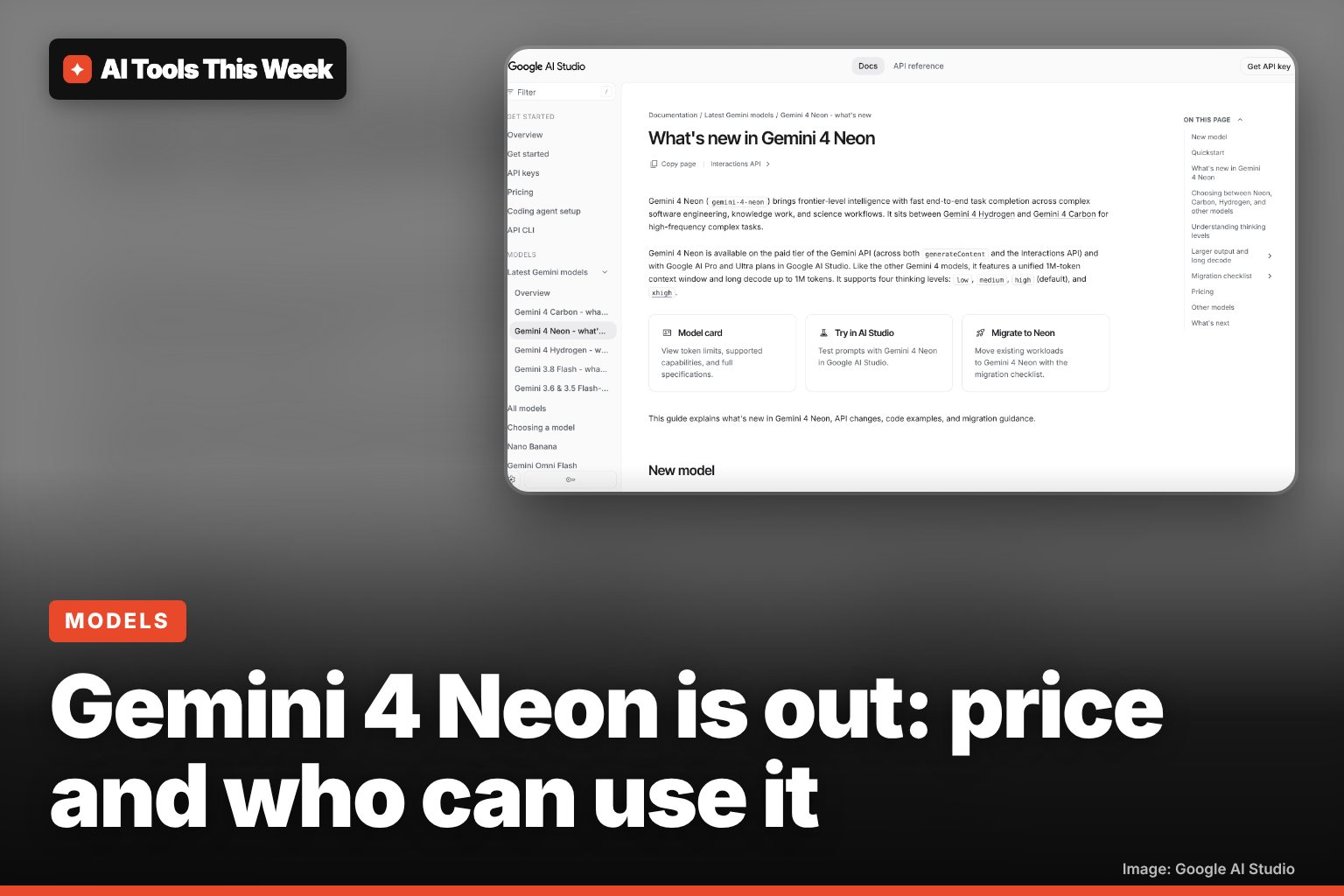
Gemini 4 Neon is in the Gemini app for AI Pro and Ultra, GitHub Copilot Pro+ and the API at $3/$15 per 1M tokens. No free tier.
Gemini Robotics 2.5: what Google's robot AI can do
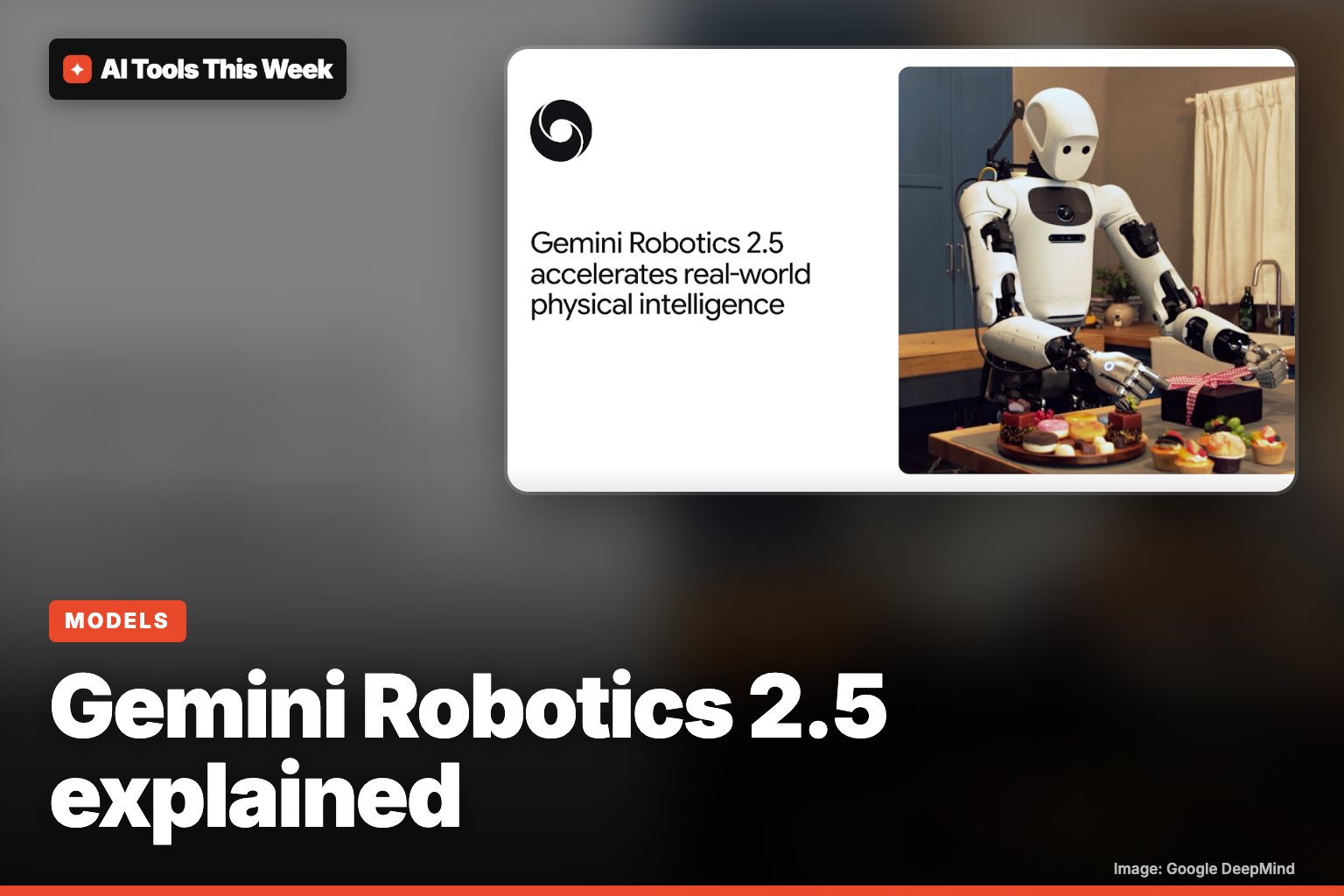
Google DeepMind's Gemini Robotics 2.5 controls robot arms and hands. What's new, the Mercedes-Benz test, who can use it and what it means for you.
Gemini 4 Hydrogen: what's new, price and who can use it
Google released Gemini 4 Hydrogen on November 12, 2026, a fast model for everyday agent work. Where it is available, what it costs and how it compares.