
Apple FastFrames: what it is and is it free to use?
Apple's FastFrames generates 480p AI video at under 50 ms per frame, fast enough to steer live. Free weights, but research-only and it needs big Nvidia GPUs.
Checked and updated 22 November 2026 at 03:45 UTC
Key points
- FastFrames is an Apple research family of AI video models (FastFrames-S, 1.3B parameters, and FastFrames-L, 14B) that generate 480p video frame by frame fast enough to react to your input as you go: 36 ms per frame for S on one Nvidia B200 GPU, 45 ms for L on eight.
- The weights and code are free to download on Hugging Face and GitHub, but Apple's license allows research use only, and running it needs a Linux PC with an Nvidia GPU. It is not an app or an Apple Intelligence feature.
- The trick: Apple found that steps people treat as fixed, like decoding images and updating the model's memory, took over half the time, and replaced them with lighter parts. Apple says S matches a model nearly 8 times slower.
FastFrames is a pair of AI video models from Apple's machine learning research team that generate video fast enough to steer in real time: under 50 milliseconds per frame at 480p. The weights are free to download on Hugging Face, but they are licensed for research only and need serious Nvidia hardware, so this is not something you can use on an iPhone or Mac today.
Apple posted the paper on November 17, 2026, and the 14B model has been climbing Hugging Face's trending list since. Here is what it does, why it matters, and how to try it.
What FastFrames does
Most AI video tools take a prompt, think for a while and hand you a finished clip. FastFrames is autoregressive: it makes the video a frame at a time and can take new input between frames. That's what you need for things that react to you, like walking around a generated world with the keyboard or dragging objects and watching them move.
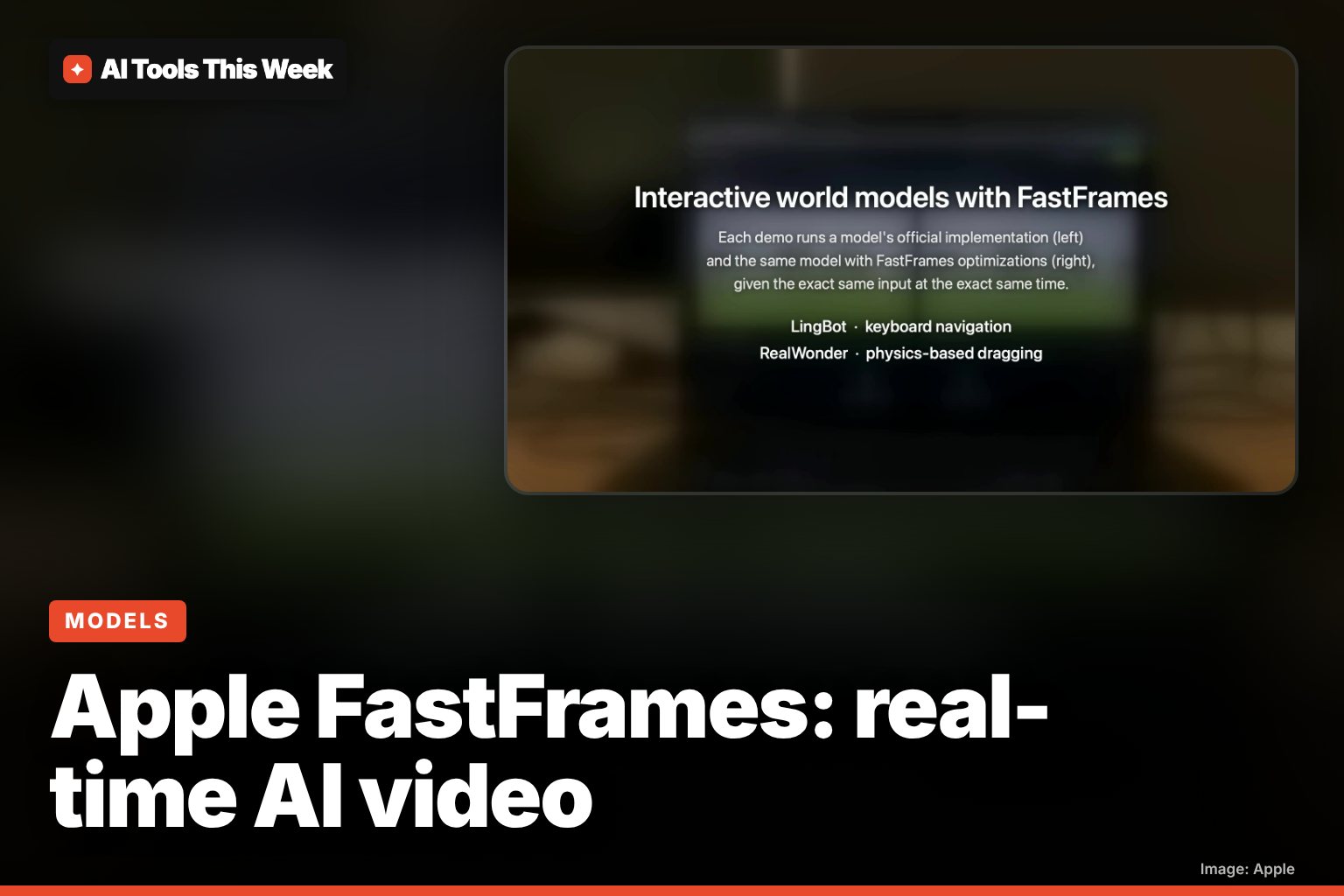
Apple's demos show two such uses side by side with the original, slower models:
- LingBot, a world model you move through with keyboard controls. Apple says its optimized version is 16 times faster than the official one.
- RealWonder, where you drag objects with physics-based motion.
It also does normal text-to-video. Apple's script outputs 832 × 480 video, 81 frames at 16 fps (about 5 seconds).
The two models
| FastFrames-S | FastFrames-L | |
|---|---|---|
| Size | 1.3 billion parameters | 14 billion parameters |
| Built from | Causal Forcing++ | Wan2.1 14B (Alibaba) |
| Speed (Apple's numbers) | 36 ms per frame on 1 B200 GPU (14 ms on 8) | 45 ms per frame on 8 B200 GPUs (158 ms on 1) |
| Responses per second | 28 | 22 |
| Apple's quality claim | Matches CF++, which is nearly 8× slower (272 ms) | Comparable to Krea-Realtime while over 10× faster (1,675 ms) |
Apple sets 50 ms per frame as the bar for "interactive". Both models clear it on Nvidia's B200 data-center chips, which cost far more than any home PC.
Why it is fast
The paper's key finding is about the boring parts. Apple profiled leading video models and found that two steps everyone treats as fixed, turning the model's internal output into pixels (VAE decoding) and updating its memory of earlier frames (the KV cache), ate up more than half of the total time. FastFrames swaps them for a tiny pixel decoder (under 1 ms) and a lightweight "KV refinement" network (about 2 ms), then generates each frame in just two diffusion steps.
Is FastFrames free?
| Question | Answer |
|---|---|
| Free to download? | Yes, weights on Hugging Face, code on GitHub |
| Commercial use? | No, the Apple Machine Learning Research Model license is research-only |
| Hardware | Linux x86-64, Nvidia GPU, CUDA 12.8 driver |
| Try without installing? | A community demo, akhaliq/FastFrames-L, runs on Hugging Face's shared ZeroGPU hardware (expect a queue) |
| In Apple products? | Not announced |
What it means for you
Nothing changes on your devices today. But FastFrames points at where AI video is going: from "wait a minute for a clip" to video that answers you live, like a game. Google is chasing the same idea with interactive worlds (see Genie 4 and Project Genie), and for a video model you can already run yourself, see our LTX-2.5 explainer. It is also one more sign Apple's research group is publishing more openly, alongside news like Apple's AI agent.
AI Tools This Week is not affiliated with Apple.
Frequently asked questions
Can I use Apple FastFrames on my iPhone or Mac?
No. FastFrames is a research release, not a product. Apple's own instructions require Linux on an x86-64 PC with an Nvidia GPU and CUDA 12.8, and its speed numbers come from Nvidia B200 data-center GPUs. There is a community demo on Hugging Face Spaces if you just want to try it in a browser.
Is FastFrames free for commercial use?
No. The model weights use the Apple Machine Learning Research Model license, which allows use, changes and sharing only for research purposes. The bundled LingBot demo follows a non-commercial CC BY-NC-SA 4.0 license.
What is FastFrames-L based on?
FastFrames-L starts from Alibaba's open Wan2.1 14B text-to-video model, which Apple distilled into a fast two-step model. FastFrames-S builds on the Causal Forcing++ research model.
Sources
Related
Inkling 2 Mini: what it is, is it free, can it run on a Mac?
Thinking Machines' Inkling 2 Mini is a free Apache 2.0 open model (26.4B, 3.4B active) that runs on a Mac with 32GB of memory. Specs, scores, prices.
FLUX 3 Image Klein: is it free, and can your PC run it?
FLUX 3 Image Klein is Black Forest Labs' 5.6B open image model. It's free for small businesses, runs on 8 GB GPUs, and costs $0.009 per image in the API.

Haru-4B: the open AI voice model that talks and listens at once
Haru-4B from Japan's higurashi is a free, open voice model that listens and speaks at the same time, in 9 languages. What it does and how to run it.