
Claude black hole physics: 2 open problems solved (Nov 2026)
Anthropic says Claude Fable 5.2 agents solved two open black hole problems: the Hawking-Page transition is abrupt, and a new 3D gravity mass limit.
Checked and updated 20 November 2026 at 04:30 UTC
Key points
- Anthropic says a small team of Claude Fable 5.2 agents solved two open problems in theoretical black hole physics, published on November 17, 2026.
- One result finishes a calculation set up in 2003 and shows the Hawking-Page transition is abrupt; the other gives an exact new mass ceiling for black holes in 3D quantum gravity, checked in the Lean proof checker.
- Anthropic is clear that neither result describes our own universe or has practical uses. For normal users it is a sign of how far long-running AI agents now go, not a new feature.
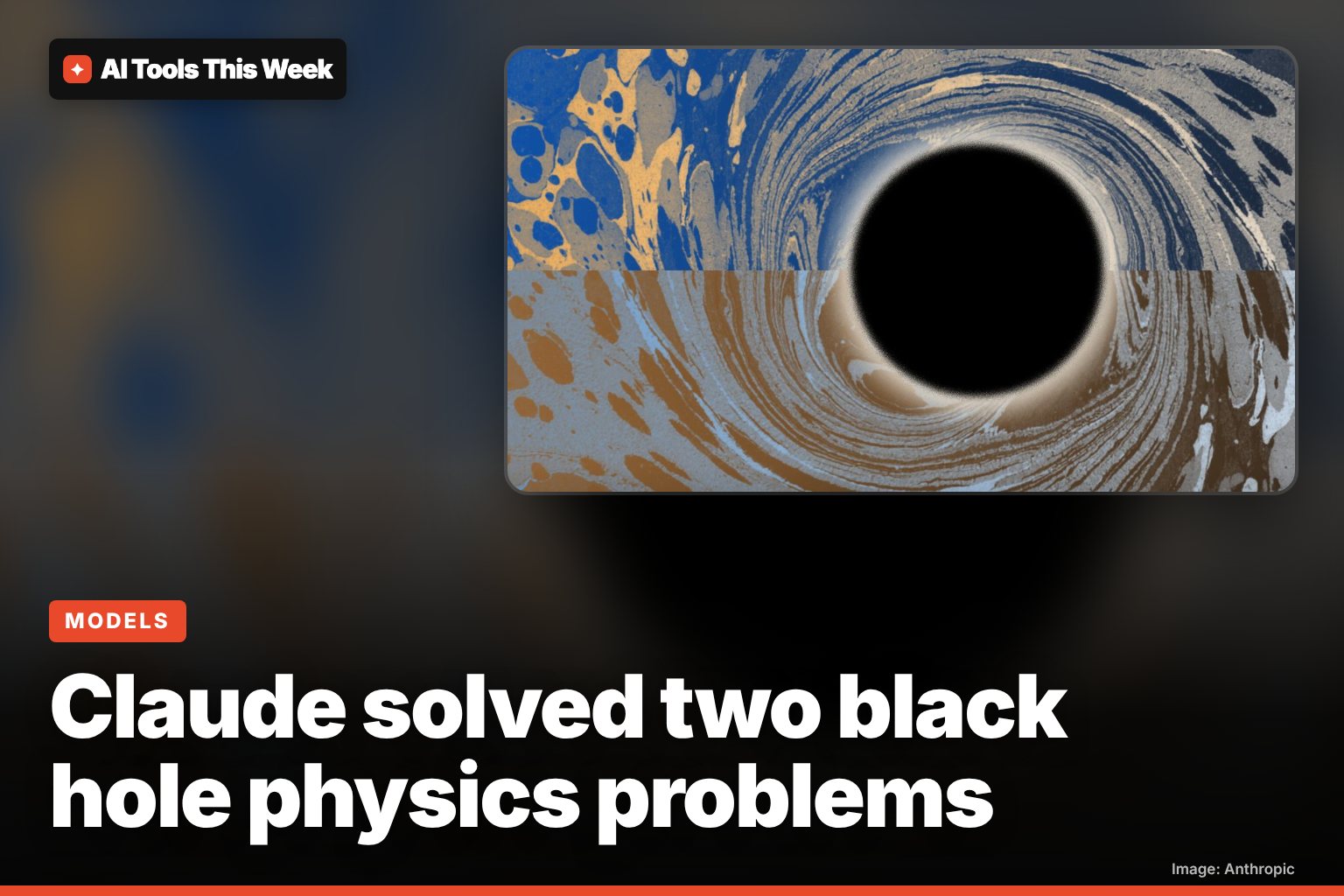
Anthropic says Claude Fable 5.2 has solved two open problems in the physics of black holes. In a research post on November 17, 2026, the company describes one result that finishes a 20-year-old calculation about how black holes form, and a second that sets an exact new limit on black hole mass in a simplified 3D model of quantum gravity. Both papers are online.
The story hit the top of Hacker News this week alongside Anthropic's stock market debut, so here is what was actually found, how it was checked, and what it means if you just use Claude for everyday work.
What Claude found
| Problem | Open since | What Claude found | How it was checked |
|---|---|---|---|
| Hawking-Page transition at weak coupling | Set up in 2003, never finished | The switch from a hot gas of particles to a black hole is abrupt, not smooth | Most steps done twice by independent agents, checked against published results and a physicist's separate calculation |
| Modular bootstrap mass ceiling (3D quantum gravity) | Long-standing | An exact formula, M₁ ≤ c/Λ with Λ ≈ 9.1266, and a proof that this simple method cannot go lower | Two other agents reached the same answer; formally verified in Lean; every main result checked by a physicist |
The first result is about a model universe described by a theory called N=4 super Yang-Mills. In 1983 Stephen Hawking and Don Page showed, using gravity, that heating such a universe makes it switch suddenly into a black hole. Physicists wanted to know if the same sudden switch shows up in the quantum theory on the other side, in a regime that is easier to calculate. The calculation was set up in 2003 and left unfinished. Anthropic says Claude completed it and found the switch is abrupt, which suggests black hole formation is built into the quantum theory itself.
The second result is about putting a ceiling on how heavy the lightest black hole can be in three-dimensional quantum gravity. Claude brought in a tool called a spectral curve, which had not been used on this problem, derived an exact formula and proved it is the best the simplest version of the method can do.
How the agents worked
The project started as a side experiment by Anthropic researcher Hongbin Chen. He asked Claude for open problems about black holes and the bootstrap method, and it suggested 22. Chen set up a separate group of agents for each, and they ran in the background for about six weeks. Two of those problems are the ones now published. Claude wrote the bootstrap paper with little guidance, according to Anthropic.
Anthropic also notes that one agent reproduced a sphere-packing result that an OpenAI model proved recently, a sign that labs are now competing on research-grade maths and physics.
What Anthropic says it does not mean
The post is unusually direct about the limits:
- Neither result describes our own universe, and neither has practical applications.
- Neither settles the question of quantum gravity, "or even comes close".
- The bootstrap method alone cannot push the mass ceiling down to the value physicists expect, so other ideas are still needed.
Independent review by outside physicists will take longer than a news cycle, so treat these as strong claims with published papers, not settled textbook results.
What it means for you
Nothing changes in the Claude app today. The useful takeaway is about agents: the same model you can chat with produced this work when it ran for weeks as a team, checking each other's steps. That is the direction every big lab is heading. If you want to understand the model involved, read our explainer on Claude Fable 5.2, and for the basics of agents see what is an AI agent. For how this week's model race looks, see Gemini 4 Neon vs Claude Opus 5.5, and for the company's big week on Wall Street, our Anthropic IPO page.
AI Tools This Week is not affiliated with Anthropic.
Frequently asked questions
Did Claude really solve open physics problems?
Anthropic says so. Its November 17, 2026 post describes two results found by Claude Fable 5.2 agents, with both papers posted online. Steps were checked by independent agents, one result matched a physicist's separate calculation, and the other was formally verified in Lean and checked by a physicist. Wider review by other physicists will take time.
Which Claude model solved the black hole problems?
Claude Fable 5.2. Several copies of the model ran as a small research group in the background for about six weeks.
Can I use Claude for research like this?
The model is the same Claude Fable 5.2 available to paying users, but this project ran many agents for weeks with a researcher setting them up. A normal chat will not do six weeks of work on its own.
Sources
Related
Riemann hypothesis proof with Claude: Lean certifies it (Nov 2026)
Yes, the computer check passed: on Nov 21 the Lean and Mathlib communities certified Levent Alpöge's Claude-made Riemann hypothesis proof. Human review is next.
Claude Fable 5.2: what's new, price and who gets it
Anthropic released Claude Fable 5.2 and Mythos 5.2 on November 9, 2026. Here is what changed, what it costs and which one you can actually use.
Gemini 4 Neon vs Claude Opus 5.5: price, limits, which to pick
Gemini 4 Neon costs $3/$15 per 1M tokens, Claude Opus 5.5 $4/$20. Both have 1M-token context. Side-by-side specs, costs and where each one works.