
Idol image-to-3D model: what it is and is it free?
Speridlabs' Idol turns one photo into a 3D Gaussian splat, including the sides you can't see. Free under Apache 2.0, but it needs an NVIDIA GPU.
Checked and updated 15 November 2026 at 21:25 UTC
Key points
- Idol, from Speridlabs, turns one image of an object into a 3D model made of Gaussians (a "splat") that you can spin around, including the sides the photo never showed.
- It's free and open source under Apache 2.0, with a free demo on Hugging Face, and it has become one of the most-liked trending models there with about 2,360 likes.
- To run it yourself you need an NVIDIA GPU with about 8 GB of memory; one object takes about 19 seconds on an RTX 4090 and about 7 seconds on an H100.
Idol is a free, open-source AI model from Speridlabs that turns a single picture of an object into a 3D model you can rotate, filling in the sides the picture never showed. It's released under Apache 2.0, you can try it free in the browser, and running it at home needs an NVIDIA graphics card with about 8 GB of memory.
Idol is one of the most-liked trending models on Hugging Face this week (about 2,360 likes and 33,000 downloads in the last month), so here's what it actually does and whether it's worth trying.
What Idol does
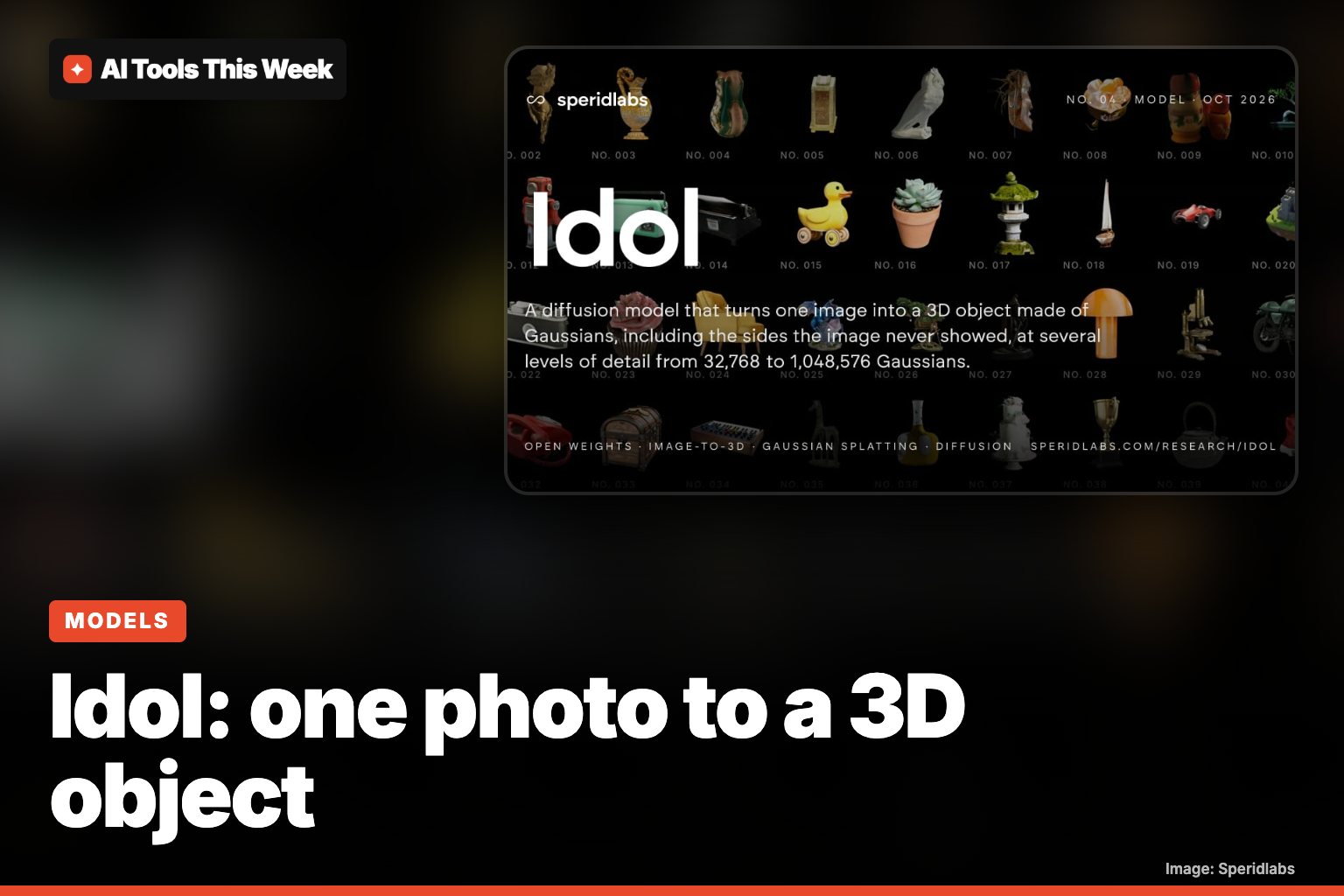
You give it one image: a product photo, a render or an AI-generated picture. Idol removes the background, frames the object and outputs a 3D Gaussian splat, a cloud of up to about a million small coloured blobs that looks solid when you view it from any angle (project page).
For each image you get three files (model card):
name.ply: the 3D splat, in the standard format most splat viewers openname_input.png: the cleaned-up image the model actually sawname_camera.json: the camera angle it thinks the photo was taken from
You can choose the level of detail, from 32,768 to 1,048,576 Gaussians. The default is 262,144.
Is it free, and how do I try it?
Easiest: open the Idol demo on Hugging Face and upload a picture. No install needed.
On your own PC (from the model card):
- Have an NVIDIA GPU with CUDA, Python 3.10+ and PyTorch 2.5+.
- On Hugging Face, accept the terms for two gated models it borrows parts from: Meta's DINOv3 image encoder and Black Forest Labs' FLUX.2-dev (only its VAE is downloaded). Log in with
hf auth login. - Clone
speridlabs/idol-sdkfrom GitHub and runpip install -e .. - Run
python -m idol.sample --image photo.jpg --mode realfor a photo, or leave--modeon the defaultsyntheticfor renders and AI images.
The weights download on first run (about 3 GB). The very first image is slower while it compiles.
How fast is it?
Speridlabs' timings for one object at default settings (median of 8 images):
| GPU | Time per object |
|---|---|
| B200 | 3.6 s |
| H100 | 6.7 s |
| RTX 5090 | 14.1 s |
| RTX 4090 | 19.1 s |
| RTX 3080 | 46.2 s |
| L4 | 54.6 s |
Memory peaks at about 7.2 GB. The core model is about 0.66B parameters, or 1.8B counting the background remover, image encoder and VAE it uses.
How it compares
On Speridlabs' own test (8 views per object, one H100), Idol beat TRELLIS, TripoSplat and LGM on most quality scores, including shape overlap (IoU 0.862) and visual similarity (CLIP 0.885). LGM is far faster at 1.1 seconds and scores slightly higher on PSNR, but the authors point out its results look blurry. These are the maker's numbers, not an independent test.
Who it's for
It's a fit for game and AR prototypers, online shops that want a spinnable product view, and hobbyists curious about 3D. Note that a splat isn't a mesh, so it won't go straight into a 3D printer or most game engines without converting it.
The project page dates Idol to October 2026 and credits Alejandro Cañada and Chema Garabito. For other open models you can run yourself, see Qwen3.8-27B and the LTX-2.5 video model, or start with our guide to on-device vs cloud AI.
AI Tools This Week is not affiliated with Speridlabs.
Frequently asked questions
Is Idol free to use?
Yes. The weights are on Hugging Face under the Apache 2.0 license, which allows commercial use, and the code is on GitHub. You can also try it in the browser through the free Hugging Face Space. You pay only for your own hardware.
Can Idol make a 3D model for 3D printing?
Not directly. Idol outputs a Gaussian splat (.ply), which is a cloud of soft, coloured blobs made for viewing, not a solid mesh. You'd need a separate tool to convert a splat into a printable mesh.
Does Idol run on a Mac?
Not officially. The model card lists an NVIDIA GPU with CUDA, Python 3.10+ and PyTorch 2.5+ as requirements. On a Mac, use the Hugging Face demo instead.
Sources
Related

Haru-4B: the open AI voice model that talks and listens at once
Haru-4B from Japan's higurashi is a free, open voice model that listens and speaks at the same time, in 9 languages. What it does and how to run it.

Qwen3.8-27B: what it is, is it free and can you run it?
Alibaba's Qwen3.8-27B is a free, open AI model that runs on a strong home PC. What it does, file sizes, how to install it and benchmarks.
ZONOS3-Mini: what it is and is it free? (Nov 2026)
Zyphra's ZONOS3-Mini is a free, open-source text-to-speech and voice cloning model that runs in your browser. Features, languages, limits.